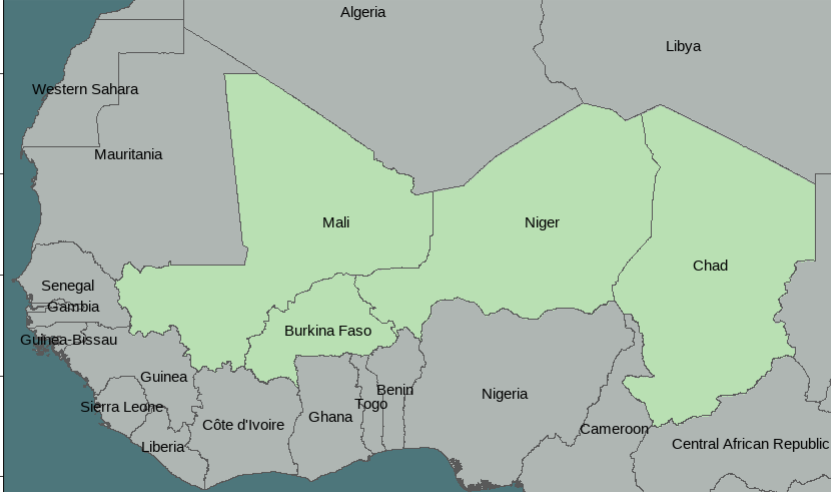
Below are the resources available for a crisis simulation for a basic or advanced undergraduate course in international relations or world politics. The region for this simulation is the Sahel region of Africa. The learning goals for this simulation include: Developing individual research skills about under-reported regions, presentation and negotiations skills, grounded knowledge about West African politics, and the ways in which actors respond to crises in international relations.
Best Fit: 7 Groups (2-3 students per group), undergraduate International Relations course. Adaptable to other requirements.
The basic structure of the simulation is:
flowchart TD
  A[Assign Roles] ==> B[Student Research]
  B ==> C[Group Presentations]
  C ==> D[Crisis Simulation]
  D ==> E[Medium-Term Negotiations and Debrief]
flowchart TD
  A[Assign Roles] ==> B[Student Research]
  B ==> C[Group Presentations]
  C ==> D[Crisis Simulation]
  D ==> E[Medium-Term Negotiations and Debrief]
Why the Sahel? This simulation aims to engage students in a thorough unpacking of a political crisis in the Sahel region and then critical thinking about the best way to move forward. The Sahel is a great region for studying this in international relations courses because it touches on many different aspects in the modern world: 1. Poverty and sustainability, 2. Crisis of democracy, 3. Regional governance and fatigue, 4. Colonial relations, 5. Radical Islamic actors, and 6. Misinformation and disinformation on social media. In the simulation, students will portray one of seven different actors in the Sahel region and seek to make agreements with other actors to create a more secure region. The preparation by students will take a couple of weeks, there should be two classes for group presentations, and then two classes for the simulation itself.
The simulation can proceed through the following stages.
Assign Roles: At least a week before the simulation, you want to assign roles to the students. The Simulation will have 7 groups and multiple students can be assigned to each groups.
Student Research: Students should engage in independent research on the simulation topic. You can also prepare background briefs on each role depending on your own personal learning goals. To encourage student research, there is a background brief of the overall context provided and a research guide for their own research (you can choose to have students submit this or just use it to guide their research).
Presentations: Students will get to know their own role very well, but the presentations are crucial to establishing a general understanding of the relationships between the different groups. An effective presentation schedule is spread across two classes. There is a basic rubric to adapt to your needs below.
Simulation: Day 1. On the first class of the simulation, the instructor will sit students in their groups (with name tags to identify their country). The students will respond in an open-floor negotiation to an escalating series of international crises. The basic slide deck of the escalating crisis will be below.
Simulation: Day 2. On the second class of the simulation, the instructor will tell the students that the initial crisis has passed and a regional conference has been called to discuss medium-term security issues. A script for beginning the discussion is below. Students will develop a negotiated agreement to avoid crises in the future. This simulation will be an ordered-meeting negotiation. The last 15 minutes should be spent on a de-briefing where students will leave their roles and discuss some key themes. A debriefing script is available below.
Tina M. Zappile, Daniel J. Beers, Chad Raymond, Promoting Global Empathy and Engagement through Real-Time Problem-Based Simulations, International Studies Perspectives, Volume 18, Issue 2, May 2017, Pages 194–210, https://doi.org/10.1093/isp/ekv024
Statement
Simulations, and particularly those involving war and conflict, are teaching tools that require significant ethical engagement by instructors. They may involve aggression between participants in the classroom, they may marginalize or bring focus on some students, and they may treat real decisions involving life and death as video games or strategic decisions without real costs. The 2024 Sahel simulation has two aspects which aim to manage these ethical challenges: 1. Debriefing. Any class where some students are portraying other actors should include a debriefing. Depending on how the simulation went and the dynamics of your classroom, a longer debriefing can be warranted. 2. Decision-making suspended. Aggressive actions in a classroom environment can be part of an enriching educational experience; however, I have had better results when the focus is on agreement rather than action. Hence, the crisis simulation is built around building agreement rather than taking actions. Decision-making is somewhat suspended in that context. You may of-course adjust the simulation based on your particular teaching goals or institutional requirements.
Simulation Types
Simulation Types
Ordered-Meeting Negotiations - In these simulations, students are simulating a very formal and ordered diplomatic meeting. In this type of simulation, students sit with their group and every group sees every other group. Opening these simulations with opening statements gets every group involved and then the chair/instructor should structure the discussion around key themes.
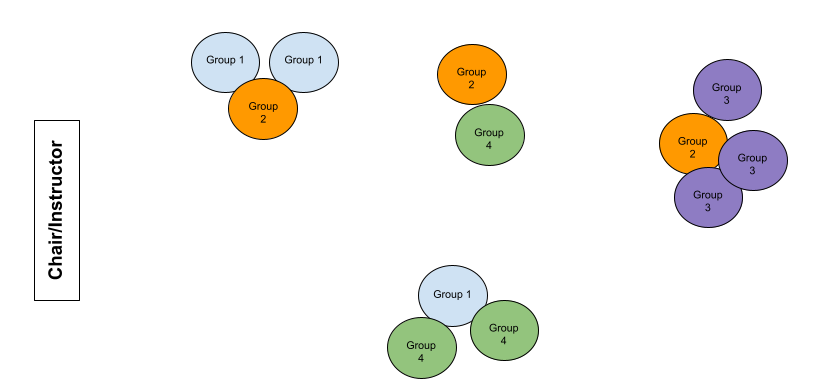
Open-Floor Negotiations - In contrast with the ordered meeting above, this one is much more chaotic. In this one, students can move around the room and talk with each other in focused negotiations. The first few minutes will often be fairly limited so increasing the tension or using other tools of inducing action may be necessary. Groups do not need to stay together and can engage in multiple negotiations simultaneously. For example, in the depiction below: Group 1 has divided between a meeting with Group 4 and Group 2. The members of Group 2 have spread all their members to different groups. In contrast, Group 3 has chosen to stay together and engage in negotiations as a unified group. All can be useful.
Logic Simulations - In these simulations, the learning goal is often to get students to understand the underlying logic of theories. You can illustrate classic aspects using the Dictator Game, the Prisoner’s Dilemma, and others. These typically operate best in small groups of students, often just two students working together.
Roles
The Sahel Crisis Simulation has 7 roles.
Mali - The government of Mali, currently run by a military junta headed by Assimi Goïta.
Chad - The government of Chad, currently led by President Mahamat Déby, son of Idriss Déby (President 1990-2021).
Burkina Faso - The government of Burkina Faso, currently a military junta led by Ibrahim Traoré
Niger - The government of Niger, currently run by a military junta headed by Abdourahamane Tchiani.
Coalition des Mouvements de L’Azawad (CMA) - The CMA is an umbrella group of many pro-independence groups in Northern Mali. Mostly composed of ethnic Tuareg groups, these groups signed a peace agreement with the government of Mali in 2015. This agreement was cancelled by the government of Mali in 2024.
ECOWAS - The Economic Community of West African States is a multilateral organization linking together countries along the coast of West Africa with those in the Sahel region. It formally includes 15 members in the country, but in recent years Burkina Faso, Guinea, Mali, and Niger have been suspended.
France - France was the colonizer of much of the Sahel, particularly in West Africa. They colonized all of the other countries in this simulation. Since those countries gained independence, France has continued playing an active role in the region. France has led multiple military operations throughout the region and retains strong economic ties to the countries in the region.
Modifications: Depending on your needs, the simulation can be run without France. Or the leaders of ECOWAS can be split into Nigeria, Ghana, and Côte d’Ivoire. Algeria or the United States can also be added to the simulation without significant changes.
Research
Background Sheet
Background Resources
The conflict in the Sahel is, of course, multifaceted and has a wide range of positions and opinions. This is made more complicated by the general lack of interest in media coverage and the difficulty in reporting or speaking out in countries under military rule. However, some good general resources to start are highlighted below.
Here is a proposed guide to have students fill out prior to the simulation. You can have them answer these questions in groups and turn them in and/or have them use them for their presentation. Adjust as needed.
Simulation
The simulation here is planned to involve two separate classes:
Day 1- A crisis simulation. This is what I call an open-floor negotiation, where students are presented with an increasingly challenging set of problems. In these simulations, the groups cannot take actions, they can make agreements.
Day 2- Future planning and Debrief. This simulation is more organized setting and takes the form of an ordered-meeting negotiation. Students will discuss forward planning and then be debriefed about the simulation.
Class 1
Below is the simulation Powerpoint (updated: 10 May 2024). There are two slides setting the start of the simulation and then 10 to escalate the crisis and make it more complex. You will find the flow of slides that works for you, but in general I try to go about 5 minutes between slides. The agreement sheets for students to fill out are below. I usually print between 30-50 forms for a class.
Slide Deck
Agreement Sheet
Class 2
For Day 2: Student should sit with their groups. The class should start with a continuation of the simulation.
You should know what the agreements made by the groups to adjust the statement below. If they did not make an agreement, the script should be that the United Nations has convened a meeting in Geneva to discuss the key issues.
Proposed Script to open the simulation: In the previous simulation, we dealt with an escalating crisis. For today, the crisis is not escalating. All the events that happened are occurred, but the tension reduced. All your agreements are part of the context for our discussion today. You all agreed to a meeting in [XXXXXXXXXXXX] to discuss [YYYYYYYYYYYY]. This is that meeting. You all are still representing your country or organization in a discussion about how the security situation in the Sahel region can be improved to prevent a cascading crisis. Your group will have 5 minutes to present a 1-minute proposal on the key issues regarding [YYYYYYYYYYYYY]. After each group has presented, the floor will be open to develop a formal proposal from this group. For today’s meeting, we are requiring unanimous agreement, so everyone here must agree to the proposal.
Proposed Script for de-brief: That concludes the simulation. We are no longer adhering to our roles but thinking about what the simulation teaches us about international relations and crisis diplomacy. I would like to hear from everyone some answers to the following questions:
Reflecting on the crisis simulation- What were the challenges your group faced during the crisis in terms of pursuing your goals?
What were the challenges during the crisis in reaching collective agreement?
Reflecting on the meeting today: What were the challenges with crafting a longer term regional security situation?
Reflecting on the overall simulation: What were the challenges with being someone else? How did these challenges impact your behavior in the simulation?
Let’s focus in the end on the real implication here: Millions of people are being harmed by violence and insecurity in the Sahel region. After the simulation, what options do you think there are for improving the security for those people?